Zoho CRM Audit, Redesign & Stabilisation
Your CRM should drive the business. Not create more administration.
If your CRM isn't supporting sales, customer relationships and management decisions, something needs to change.
A CRM can contain all the right features and still fail to support the organisation. Infolytics helps businesses understand why their CRM isn't working, identify the underlying problems and engineer a system that supports how the business actually operates.
No product pitch. We start with the business problem.
Trusted by organisations across Southern Africa


You invested in CRM. Why is the business still working around it?
You may recognise some of these problems:
- Sales teams avoid updating the CRM.
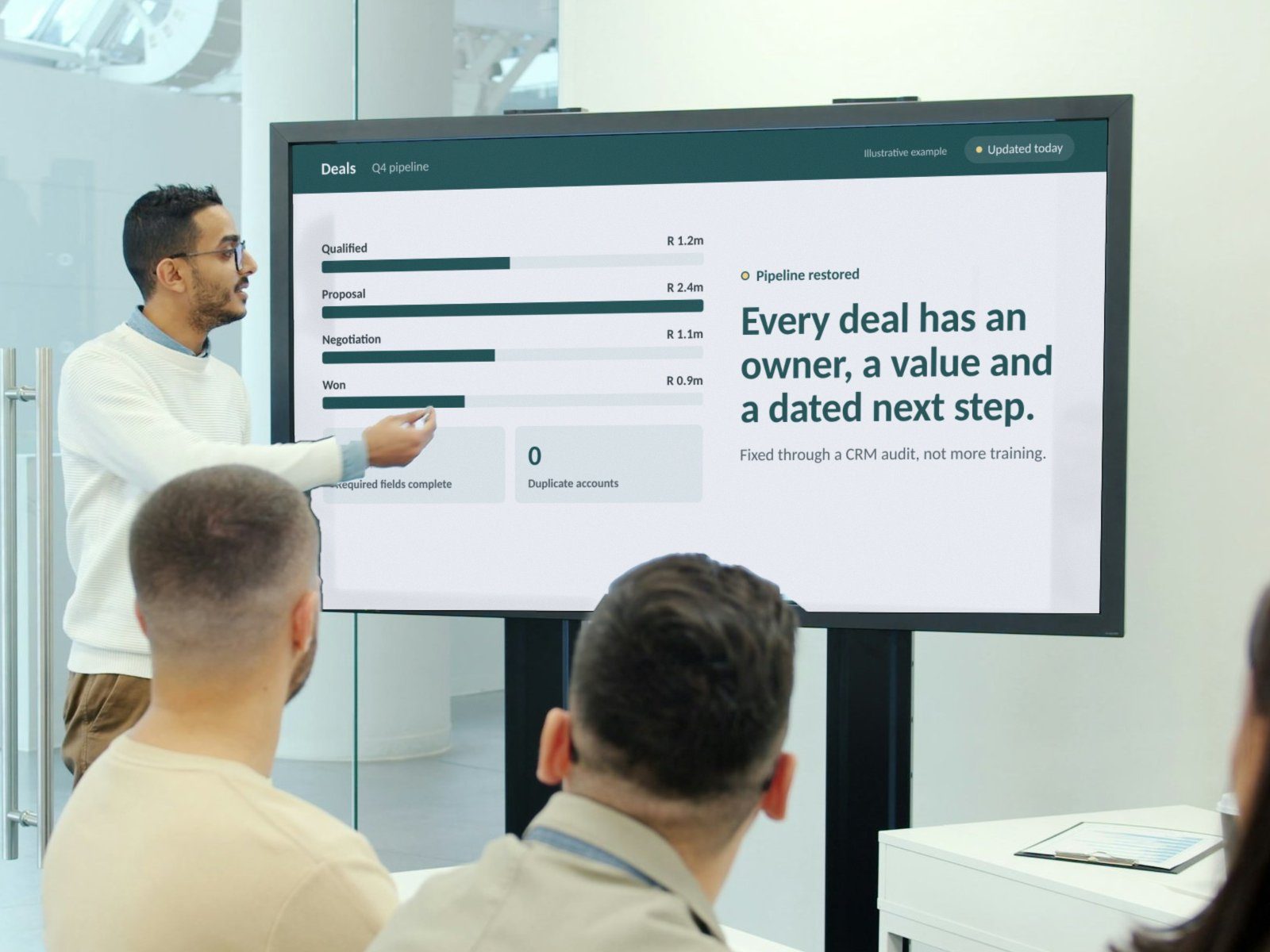
- Pipeline information doesn't reflect reality.
- Management struggles to trust forecasts.
- Leads and opportunities remain unattended.
- Customer information is incomplete or duplicated.
- Workflows and automations behave unpredictably.
- Teams still maintain separate spreadsheets.
- Reports exist but don't support meaningful decisions.
- Customer handoffs between departments are inconsistent.
- Changes to the CRM create unexpected downstream problems.
A CRM that isn't trusted becomes another administrative obligation instead of an operational asset.
The problem isn't always user adoption.
When employees resist a system, the immediate response is often more training. But low adoption can also indicate deeper structural problems.
The CRM may not reflect the actual sales process. Too many fields may be required. Users may have to perform unnecessary steps. Automations may create confusion rather than remove work. The underlying data and reporting structures may be wrong.
We assess the system and its operating context before deciding what needs to change.
What is preventing your CRM from delivering value?
Select all that apply.
0 problem areas identified
This is a starting point for the conversation, not an audit. Findings can only be verified through a formal Zoho System Audit.
Where we would start looking
What we examine
- Business process alignment
- Does the CRM reflect how leads, opportunities and customers actually move through the business?
- Adoption and usage
- Are teams using the system consistently, and where is usage breaking down?
- Data quality
- Is the information sufficiently complete, consistent and reliable for its intended purpose?
- Automation and configuration
- Are workflows, rules and configurations serving the business correctly?
- Pipeline and management visibility
- Can management understand performance and make decisions using CRM information?
- Security and governance
- Are permissions, responsibilities and controls appropriate?
- Integrations
- Does the CRM exchange information effectively with finance, customer service and other systems?
- Architecture and maintainability
- Can the CRM support future changes without accumulating unnecessary complexity?
Audit first. Engineer the right changes.
Assess the environment
Understand the configuration, operational usage, process alignment and reported problems.
Identify the underlying causes
Separate symptoms from system-design, process, data and adoption problems.
Prioritise the findings
Determine which issues have the greatest operational consequences.
Design the improvements
Define the appropriate process, architecture, configuration and governance changes.
Implement and stabilise
Correct the identified problems, test the solution and support adoption.
Your CRM should be a source of operational confidence.
Not just a place where information is stored. It should support accountability, customer relationships, pipeline management and dependable decision-making.

What happens when the system works.
Our customers bring us different problems. The common thread is complexity: processes, systems, data and teams that need to work together.
They are knowledgeable, honest and transparent.
What we value most is having access to senior management and domain experts when we need them.
Infolytics is the only Zoho Partner we trust.
We have been impressed by Infolytics' ability to understand our unique regional business requirements across Zimbabwe and Zambia. They are a great team and one of our best partnerships.
Who this is for
Infolytics is best suited to organisations where systems have become an important part of how the business operates. You may have:
- An existing CRM, on Zoho or another platform, that the business depends on but doesn't trust.
- An existing Zoho environment that needs to be redesigned or stabilised.
- Pipeline, forecasting and customer handoffs that matter across several teams.
- CRM data that feeds finance, service or management reporting.
If you simply need a few fields or a report added, we may not be the right partner.
If the problem crosses processes, departments, data and systems, that's where our work becomes valuable.
Before you replace your CRM, understand why it isn't working.
Tell us what's going wrong. We'll help determine whether the right next step is an audit, stabilisation, redesign or structured Discovery.
What happens when you speak to us?
This isn't a generic software demo. In the first conversation, we want to understand:
- What are you trying to achieve?
- Where is the business struggling today?
- Which processes, teams and systems are involved?
- What have you already tried?
- What is the operational consequence if the problem isn't solved?
From there, we'll recommend whether the next step is an audit, formal Discovery, solution architecture or implementation, or whether there's a simpler answer.
No sales pitch. Confidential conversation. Practical next steps.