Migration & Modernisation to Zoho
Replace the system without breaking the business.
Legacy systems create operational risk. Replacing them shouldn't introduce more.
As organisations grow, the systems they depend on can become difficult to maintain, integrate, adapt or support. But replacing an established business system involves more than purchasing new software and importing records. Infolytics engineers the transition from legacy environments to connected business systems on Zoho, with careful attention to data, processes, dependencies, controls and operational continuity.
No product pitch. We start with the business problem.
Trusted by organisations across Southern Africa


When the old system is holding the business back.
The challenges often develop gradually.
- The system no longer supports how the business operates.
- Changes require expensive workarounds.
- Critical knowledge sits with a small number of people.
- Integrations are difficult or unreliable.
- Data is fragmented or poorly structured.
- Reporting depends on manual extraction.
- Security, access control or auditability are becoming concerns.
- The organisation is exposed to unsupported technology.
- Teams resist replacement because essential processes depend on the existing system.
Eventually, the question is no longer whether the system should change.
It's how to change it without disrupting the operation.
Data migration is only one part of system replacement.
A legacy system contains more than records. It also contains years of business decisions, workflow logic, dependencies, exceptions, permissions and operating assumptions. Some of these are documented. Many aren't.
Replacing the application without understanding what happens inside it can transfer old problems into a new platform, or remove important functionality that nobody realised was critical.
That's why we begin by understanding the existing system and the business processes it supports.
What must your replacement project account for?
Select all that apply. This builds the list of areas to discuss in your consultation.
0 areas identified for discussion
A preliminary checklist, not a migration risk rating. If you have a requirements document, you can attach it in the enquiry form.
Areas to discuss
What we engineer
- Current-state assessment
- Understand the existing application, data, integrations, constraints and operational dependencies.
- Future-state solution architecture
- Define how the replacement environment should support the organisation.
- Data migration architecture
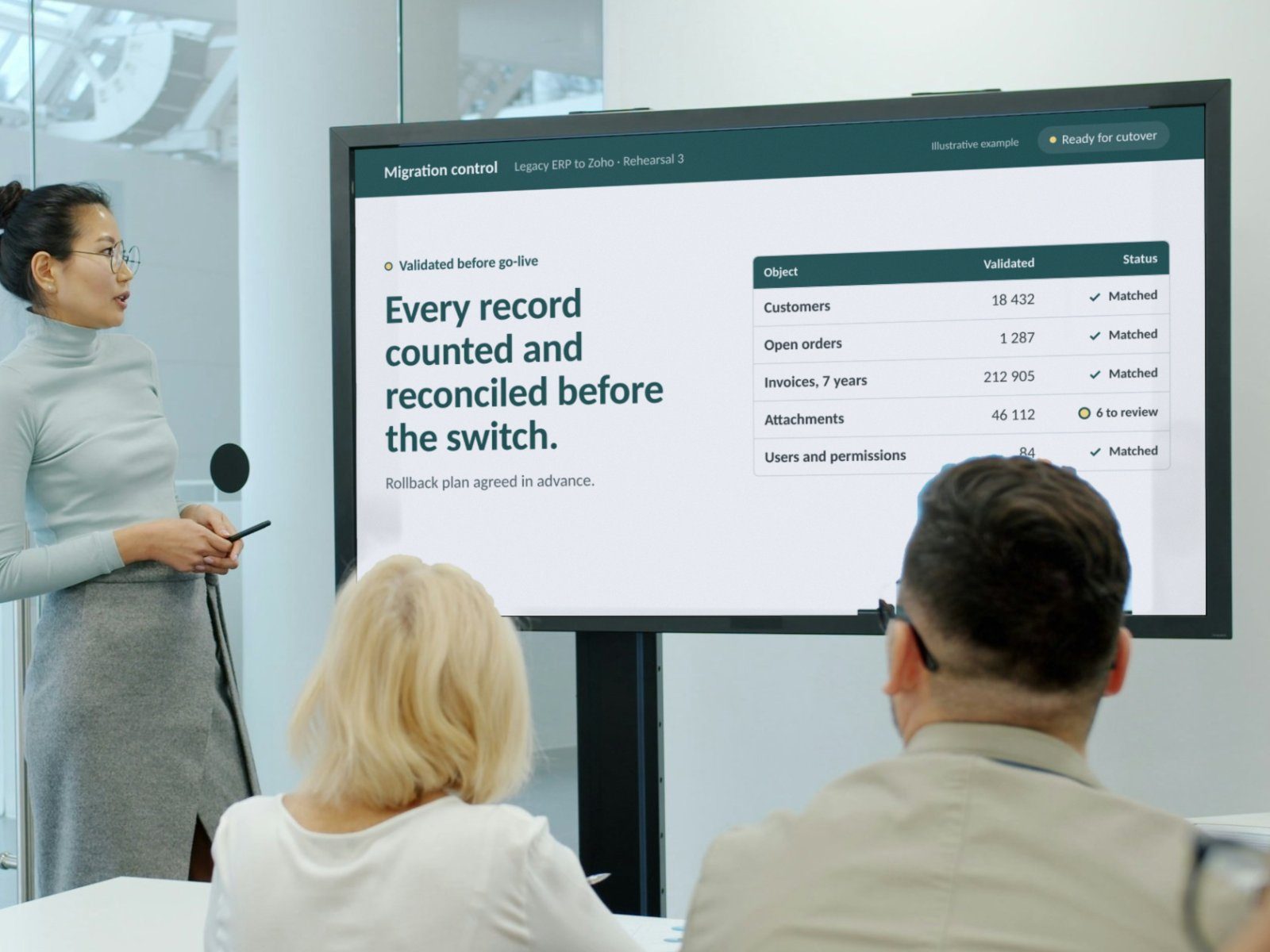
- Plan how records, relationships, attachments and history will be transferred and validated.
- Process redesign
- Identify which processes should be retained, improved, eliminated or rebuilt.
- Integration continuity
- Account for connections to other systems and external services.
- Security and governance
- Define permissions, controls, auditability and ownership in the replacement environment.
- Transition planning
- Design cutover, validation, contingency and operational readiness activities.
- Quality assurance
- Verify the new environment against agreed business requirements and acceptance criteria.
A disciplined transition.
Understand what exists
Establish the existing system landscape, business dependencies and migration constraints.
Design the replacement
Define the target operating model, solution architecture and migration approach.
Prepare the data and processes
Map source data to the new environment and resolve identified gaps.
Build and validate
Configure the replacement system, engineer integrations and test critical business scenarios.
Plan the transition
Agree on cutover activities, responsibilities, acceptance criteria and contingency arrangements.
Stabilise
Support the organisation through adoption and the early operating period.
Modernisation should move the business forward.
The objective is not to recreate every limitation of the old system in new software.
It's to preserve what the business genuinely needs, improve what isn't working and establish a more maintainable operating environment.

What happens when the system works.
Our customers bring us different problems. The common thread is complexity: processes, systems, data and teams that need to work together.
Infolytics is the only Zoho Partner we trust.
We have been impressed by Infolytics' ability to understand our unique regional business requirements across Zimbabwe and Zambia. They are a great team and one of our best partnerships.
They are knowledgeable, honest and transparent.
What we value most is having access to senior management and domain experts when we need them.
Who this is for
Infolytics is best suited to organisations where systems have become an important part of how the business operates. You may have:
- Legacy platforms or spreadsheets that need to be replaced.
- Substantial migration requirements, including history, attachments and linked records.
- Integrations or business logic that other teams depend on.
- Downtime, compliance or retention constraints.
If you simply need a spreadsheet imported, we may not be the right partner.
If the problem crosses processes, departments, data and systems, that's where our work becomes valuable.
Planning to replace a system your organisation depends on?
The earlier we understand the dependencies, the better the transition can be designed. Tell us about your current system, the reasons for replacement and the operational risks involved.
What happens when you speak to us?
This isn't a generic software demo. In the first conversation, we want to understand:
- What are you trying to achieve?
- Where is the business struggling today?
- Which processes, teams and systems are involved?
- What have you already tried?
- What is the operational consequence if the problem isn't solved?
From there, we'll recommend whether the next step is an audit, formal Discovery, solution architecture or implementation, or whether there's a simpler answer.
No sales pitch. Confidential conversation. Practical next steps.