Zoho One Solution Architecture
One business. Connected operations.
When multiple departments depend on the same information and processes, technology cannot be designed in isolation.
Sales, finance, service, operations, projects and field teams may have different responsibilities, but they are part of the same business. Infolytics engineers connected business systems that bring these functions together through shared processes, integrated applications, reliable data and appropriate controls.
No product pitch. We start with the business problem.
Trusted by organisations across Southern Africa



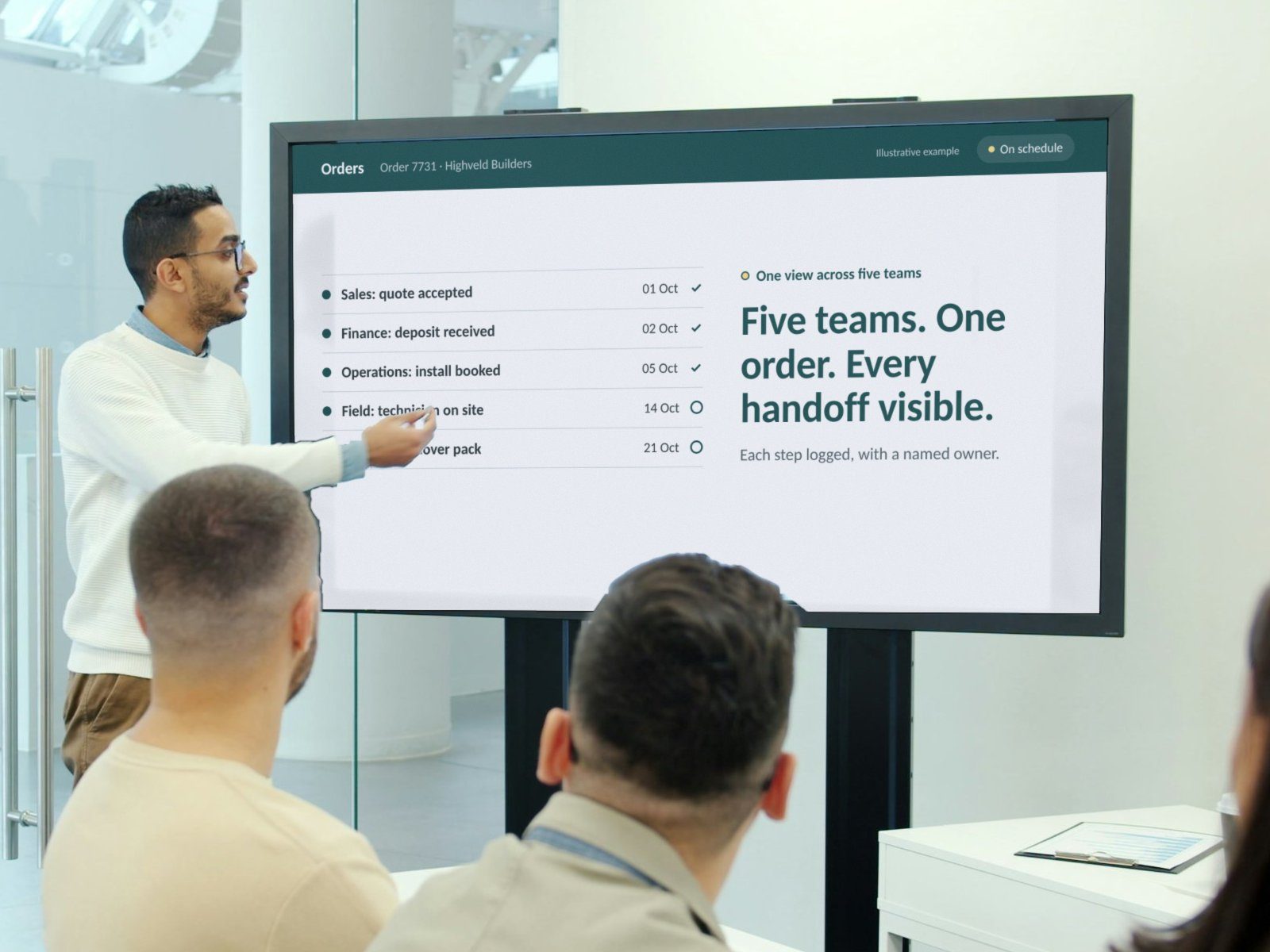
Departments are different. The business is not.
Sales needs visibility of opportunities. Finance needs control over transactions. Operations needs reliable execution. Customer service needs the complete customer context. Management needs information across all of them. The challenge begins when these functions operate independently, even though they depend on one another.
- Departments maintain separate customer information.
- One team's actions create manual work for another.
- Responsibilities become unclear at departmental handoffs.
- Processes span several applications without consistent control.
- Management must combine multiple reports to understand performance.
- Changes to one system affect other departments unexpectedly.
- Integrations are implemented without a common architecture.
- Each department optimises its own process while the wider organisation becomes less efficient.
The organisation needs more than functioning departments. It needs functioning relationships between them.
We engineer the connections between business functions.
Our work begins with understanding how the organisation operates as a whole.
We identify the processes that cross departments, the information they depend on and the decisions and controls required at each handoff. Then we engineer the supporting system architecture.
Which departments does your process cross?
Select all the departments involved.
0 departments selected
Departments in scope
The capabilities we connect
- Sales & CRM
- Customer relationships, opportunities, quoting, orders and commercial processes.
- Finance & Billing
- Invoicing, billing, subscriptions, accounting workflows and financial control.
- Customer Service
- Tickets, service channels, escalations, customer history and SLA management.
- Operations & Projects
- Work planning, task coordination, delivery and operational accountability.
- Field Operations
- Scheduling, field execution, assets and work orders.
- Data & Analytics
- Shared reporting, management visibility and operational intelligence.
- Automation & Integration
- The information and workflows that connect the functions.
- Governance & Control
- Permissions, approvals, accountability and auditability.
Architecture before applications.
We don't begin by assigning a product to every department. We begin by determining how the entire system needs to operate.
Understand the organisation
Map departments, responsibilities, processes and operational dependencies.
Define the end-to-end processes
Identify how work and information must move across the organisation.
Engineer the architecture
Define applications, data structures, integrations, controls and system responsibilities.
Implement the system
Build and integrate the applications against the agreed design.
Test across departments
Validate complete operating scenarios, not just individual applications.
Support adoption and optimisation
Prepare teams to work in the connected environment and refine the system as required.
One connected operating environment. Clearer accountability.
The result is a business system designed around the organisation, rather than individual departments making isolated technology decisions.
The intended benefits include stronger cross-functional coordination, more reliable information, improved process control and clearer management visibility.

What happens when the system works.
Our customers bring us different problems. The common thread is complexity: processes, systems, data and teams that need to work together.
Infolytics is the only Zoho Partner we trust.
We have been impressed by Infolytics' ability to understand our unique regional business requirements across Zimbabwe and Zambia. They are a great team and one of our best partnerships.
Integrated e-commerce, sales, finance, inventory and logistics into one connected operating flow.
Who this is for
Infolytics is best suited to organisations where systems have become an important part of how the business operates. You may have:
- Multiple departments working across common processes.
- Different teams needing a common view of the customer or operation.
- Complex approval or governance requirements.
- Several systems that need to exchange information.
If you need one department's tool configured, we may not be the right partner.
If the problem crosses processes, departments, data and systems, that's where our work becomes valuable.
Your business operates across departments. Your systems should too.
Let's understand how your teams, processes and information need to work together.
What happens when you speak to us?
This isn't a generic software demo. In the first conversation, we want to understand:
- What are you trying to achieve?
- Where is the business struggling today?
- Which processes, teams and systems are involved?
- What have you already tried?
- What is the operational consequence if the problem isn't solved?
From there, we'll recommend whether the next step is an audit, formal Discovery, solution architecture or implementation, or whether there's a simpler answer.
No sales pitch. Confidential conversation. Practical next steps.